
Can AI Help You Win the Lotto? An Honest Answer

I build the numbers on this site with code, so people ask me fairly often whether AI can tilt the odds. It is a good question with a boring answer, and this time I have the receipts.
The experiment: 38,190 lines, three strategies, one result
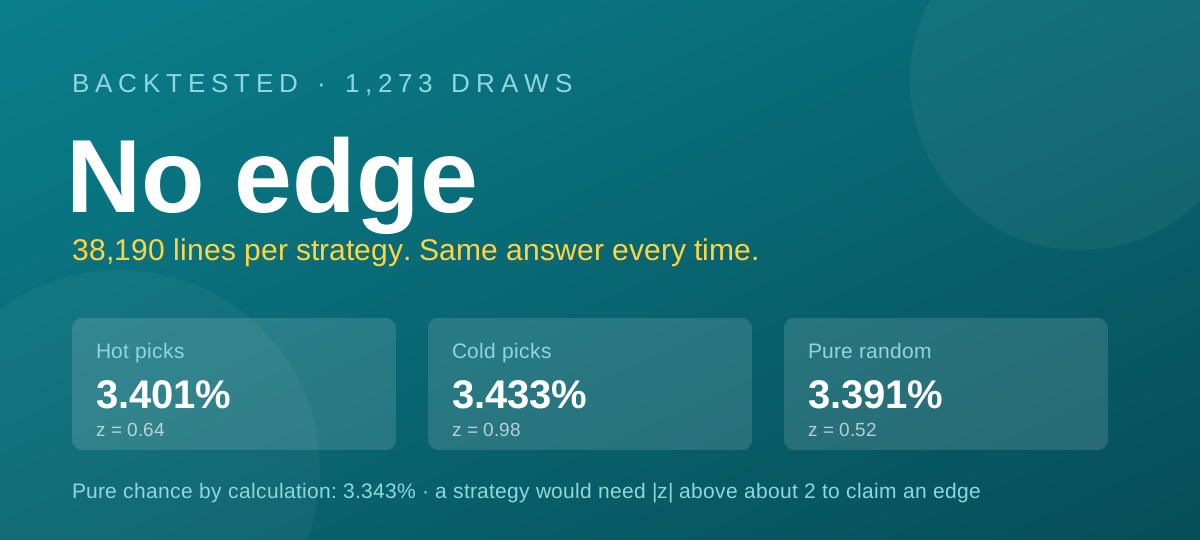
Rather than just assert it, I tested it. I took every NZ Lotto draw in our archive and ran a walk-forward backtest: for each of the last 1,273 draws, three strategies each produced 30 lines built only from the draws that came before - no peeking, no hindsight - and I scored how many lines matched 3 or more of the main numbers.
Pure chance for a single line of six numbers is 3.343%. So 30 lines should average about 1.003 three-plus hits per draw.
| Strategy | 3+ hits | Per draw | Hit rate | z vs chance |
|---|---|---|---|---|
| Hot 15 (most frequent so far) | 1,299 | 1.020 | 3.401% | 0.64 |
| Cold 15 (least frequent so far) | 1,311 | 1.030 | 3.433% | 0.98 |
| Pure random (the control) | 1,295 | 1.017 | 3.391% | 0.52 |
| Pure chance, calculated | - | 1.003 | 3.343% | 0 |
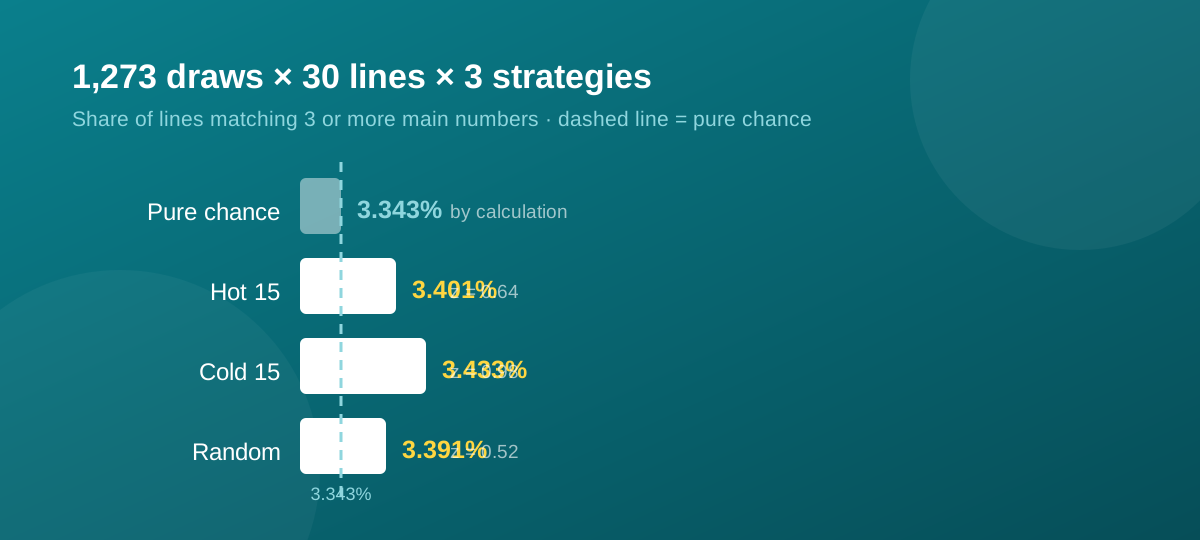
Thirty-eight thousand lines per strategy, and the spread between them is less than one standard deviation. In plain terms: for a strategy to be called genuinely better, the z-score would need to clear roughly 2. The best result in the table is 0.98 - and it belongs to the cold numbers, the ones every "system" tells you to avoid.
Read that table again and you have the whole answer to "can AI beat the Lotto". Three completely different strategies, one statistically identical result. The frequencies are real. They simply describe the past.
The one time lottery numbers really were predicted
Here is the part that makes the honest answer interesting: there is a famous case of someone predicting lottery numbers. It was not AI, and it was not mathematics.
Eddie Tipton was the information security director at the Multi-State Lottery Association in the United States - the body that supplies the random-number computers behind Powerball, Mega Millions and others. Between 2003 and 2015 he wrote code into that software that behaved perfectly on all but three days of the year: 27 May, 22 November and 29 December. On those dates, if a draw fell on a Wednesday or Saturday after 8pm, the generator produced numbers he could work out in advance.
He passed those numbers to friends and family who bought the tickets and shared the winnings. Court records put the scheme at about $2.2 million across Colorado, Wisconsin, Kansas and Oklahoma. It unravelled in 2010 when an associate tried to claim a $16.5 million Hot Lotto jackpot anonymously - something Iowa's rules do not allow. Tipton was sentenced to up to 25 years and released on parole in 2022.
His own guilty plea is the cleanest possible summary: "I wrote software that included code that allowed me to understand or technically predict winning numbers."
Notice what that sentence is not. It is not "I found a pattern in the draws". There was no pattern to find. He changed the machine.
Why that cannot happen to NZ Lotto
This is the difference that actually matters for a ticket bought here.
Every lottery needs a random source. In Tipton's case it was software - a random-number generator running on a computer, exactly the kind of system where somebody inside the building can leave themselves a door.
NZ Lotto does not work that way. The numbers come out of physical ball machines - two of them, each serving as the other's backup - and the balls are precision-made, weighed, measured and audited on a schedule. Here is the full draw process.
That distinction is the whole of it. You cannot plant a backdoor in a ball. The randomness is produced by physics - air, gravity, collisions - rather than by code anyone could edit. There is no line of software to hedge, and no three secret dates.
The honest other half: physical balls could in principle drift slightly out of true through wear, which is precisely why they are weighed and measured instead of trusted. But a bias like that is found by auditing instruments, not by an AI staring at history.
So what can AI actually do for your Lotto?
Quite a lot - just not the thing everyone wants it to do.
1. Generate genuinely random lines. Humans are bad at random. We avoid consecutive numbers, we cluster around the middle, and we over-pick everything under 32. A generator has none of those habits, so its lines look less "meaningful" - and are marginally less likely to be shared with strangers. That is the only real edge available, and it is an edge on sharing, not on winning.
2. Remember what you will forget. Whether the ticket was checked. That sales closed at 7:25pm rather than 8pm. That a ticket has been sitting in a drawer for six weeks. Software is genuinely excellent at not forgetting.
3. Keep an honest record. Every line this site publishes is scored against the draw that followed it - not only the good ones. If a service will not show you its misses, it is not showing you its record.
4. Do the arithmetic you would rather avoid. What a line really costs across a year. What the expected return actually is. How much of a budget the "one big one" argument justifies.
5. Spot the scams, including the AI-washed ones. The red flags are learnable, and almost all of them come down to one thing: anyone who needs money from you before you can collect is not a prize.
6. Make it more enjoyable without lying to you. Picking numbers is a small pleasure, and curated picks with reasons attached make that pleasure better. None of it requires pretending the odds moved.
How to spot an "AI predicts the lottery" product
The test is almost embarrassingly simple.
- Does it claim a hit rate, or show a full track record? Anyone can post a win. Ask what the misses looked like.
- Does it explain its mechanism? Real statisticians will happily explain why their method cannot beat independence. If a service cannot say what would prove it wrong, it is marketing.
- Does it ever mention sharing? If a product only talks about winning and never about splitting a jackpot, it has not thought seriously about lottery maths.
- Is there a subscription? The business model of "predicting" a negative-expectation game is the subscription.
- Does it promise a return? No strategy changes the odds. Not AI, not machine learning, not a neural network, not a quantum one.
The honest summary
AI is very good at the parts of Lotto that are about you: your budget, your record, your habits, your ability to remember a ticket in a drawer. It is useless at the part that is about the balls, because the balls have no pattern and do not care what is written about them.
That is not a disappointing answer. It is the reason the game is fair, and the reason a service that tells you so is worth more than one that flatters you.
And one last thing, since this is a page about expecting more from numbers than numbers can give: a Lotto ticket is a $2.80 entertainment purchase. The moment it becomes a plan, the maths has already stopped being on your side.
If gambling has stopped being entertainment for you or someone close to you, Gambling Helpline NZ is free, confidential, and available 24/7 on 0800 654 655.
Fancy your own set of numbers?
I'll pick 30 fresh lines for the next draw — hot, balanced and wild card.