
Why Lotto Div 1 Prize Is Shared in Two Thirds of Winning Draws

The figure that surprises people, and exactly how it is counted
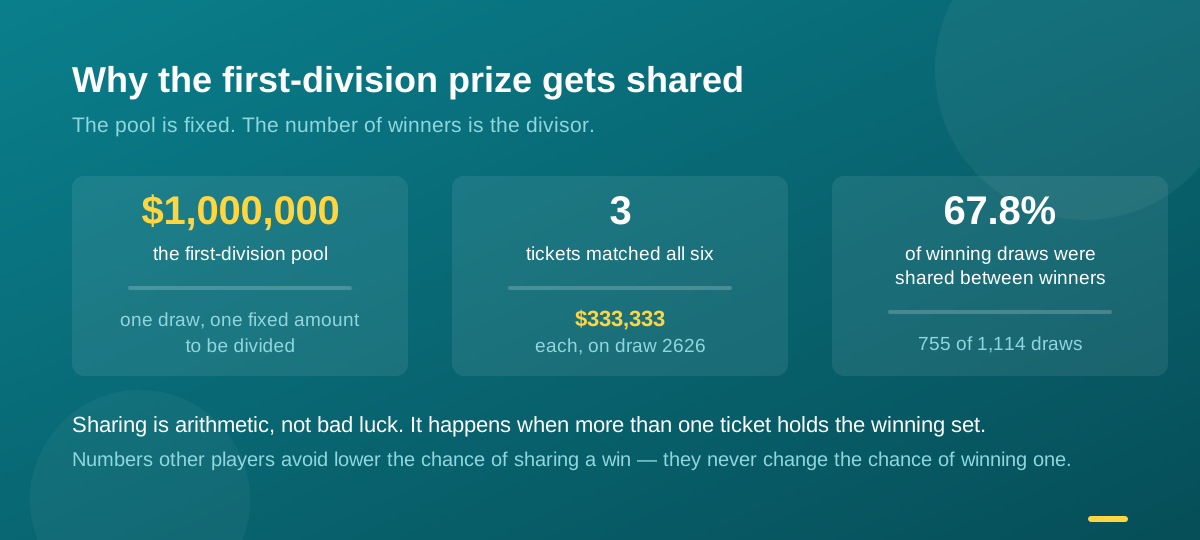
When we look at the archive of New Zealand Lotto draws, one number stands out: about 67.8 per cent of draws where someone won the first division had more than one winner. This means in two thirds of those winning draws, the prize was shared between multiple tickets. To be precise, out of 1,114 draws that had a first-division winner, 755 were shared. If you include all 1,324 draws in the archive, including the 210 draws with no first-division winner at all, the sharing rate is 57.0 per cent.
This high proportion can surprise new winners who find their prize smaller than the headline jackpot. The key is understanding exactly what that percentage means: it refers only to draws that had a first-division winner, not all draws.
The reason this figure is often misunderstood is that people sometimes expect winning the first division means a single big prize. Instead, the reality is that many winning draws have multiple winners, which means the prize pool is divided. This fact is not a quirk but simply a product of how the prize pool works and how many people pick similar numbers.
How the first-division pool is actually divided
The lotto first division prize is a pooled amount. This means all the money allocated for that division in a draw is combined into one pool. Every ticket that matches all six main balls shares this pool equally. For example, if the pool is $1,000,000 and there are three winners, each winner receives $333,333.
The division is straightforward arithmetic: the prize pool is divided by the number of winning tickets. The number of winners acts as the divisor. This is why the total prize pool size matters but the more winners there are, the smaller each individual prize.
This division rule means that a first division prize is never fixed in advance; it depends on ticket sales and how many tickets match all six numbers. The pool size can also vary depending on how much money has been rolled over or added in a particular draw.
You can read more about how the first-division pool is divided to understand why the more winners there are, the smaller the share for each.
What sharing looked like in real recent draws
Looking at examples from recent draws helps to see how sharing actually works. For instance, draw 2626 on 3 October 2026 had three winners sharing a first division prize of $1,000,000, so each winner received $333,333. Similarly, draw 2625 on 30 September 2026 had two winners who split the prize evenly, each getting $500,000. Draw 2624 on 26 September 2026 had five winners sharing the prize, each taking $200,000.
On the other hand, some draws have a single winner taking the entire first division prize. Draw 2623 on 23 September 2026 and draw 2622 on 19 September 2026 each had one winner who took home the full $1,000,000 prize.
These real examples highlight the effect of sharing: more winners mean smaller individual prizes. It also shows the variability—sometimes you win the full prize, sometimes you share it.
Sharing does not mean the prize is less than it should be; it just means it is divided. Often the headlines focus on the top prize amount, but the important figure is how many winners there were, since that determines what each person gets.
Why Powerball jackpots get shared far less often
Powerball first division prizes are shared far less frequently than standard Lotto first division prizes. In the archive of 1,324 draws, only 14 Powerball first-division prizes were split between winners.
The main reason is the much longer odds of winning Powerball first division. To win it, you must match all six main balls plus the Powerball number, with odds around 1 in 53,737,320. This makes multiple winners extremely rare.
The largest shared Powerball first division prize in the archive happened in draw 2606 on 25 July 2026, where two winners each took home $20,111,111.
Because shared Powerball jackpots are so rare, winners of these draws typically get to enjoy the full prize alone.
What choosing unpopular numbers can and cannot do about sharing
Choosing unpopular or less common numbers is a popular thought among players who want to avoid sharing the prize if they win. It is true that selecting numbers others avoid can lower your chance of sharing a first-division prize, but only if you do win.
It is important to remember that choosing unpopular numbers does not change your odds of winning. Every number is just as likely to be drawn as any other. The chance a particular six-number combination will be drawn remains constant, regardless of how popular or unpopular those numbers are.
So, what does picking unpopular numbers actually do? It can reduce the likelihood of sharing the prize because fewer players pick those numbers. But it will not increase your chance to win in the first place.
Quick Pick or Lucky Dip lines, which are randomly generated by the system, have the same chance to win as any numbers you select yourself. Their practical advantage is that they are less likely to match popular numbers chosen by others, which matters only if you win and want to avoid sharing.
You can read more about the psychology behind popular picks and why birthday numbers crowd a draw to understand why certain numbers tend to be chosen more.
Also, some players try pattern play and prize sharing strategies, but these do not affect the chance of winning—only who you might share with.
The honest limit of all of this
The honest truth is that sharing risk exists in the Lotto first division prize, and no choice of numbers can remove it entirely. The prize pool is divided among all winners, so if more tickets match the winning numbers, the prize share per winner shrinks.
No strategy can improve your chance to win, as every draw is an independent random event with equal odds for every combination. Choosing numbers only changes who you might share with, not whether you win.
Understanding this arithmetic behind the prize pool can help manage expectations. When you win, it is a great result regardless of whether you share the prize or not.
For more context on how divisions work, see the divisions explained in full, and for stories about players who have won big, check out New Zealand's biggest wins.
If gambling stops being fun, free support is available from the Gambling Helpline on 0800 654 655.
Quick answers
What percentage of Lotto first division prizes are shared between multiple winners?
About 67.8 per cent of draws that had a first division winner were shared between two or more winners, based on 1,114 draws with a winner in the archive.
How is the Lotto first division prize divided among winners?
The prize pool is divided equally among all tickets that match all six main balls. For example, a $1,000,000 pool with three winners pays $333,333 each.
Why are Powerball jackpots shared less frequently than Lotto first division prizes?
Powerball jackpots are shared less often because the odds of matching six main balls plus the Powerball are about 1 in 53.7 million, making multiple winners rare.
Does choosing unpopular numbers increase your chance of winning or avoiding sharing?
Choosing unpopular numbers does not increase your chance of winning. It only lowers the chance of sharing the prize if you do win, by reducing how many others pick the same numbers.
Fancy your own set of numbers?
I'll pick 30 fresh lines for the next draw — hot, balanced and wild card.