
Why Lotto's First Division paid just $111,111 this week

A tiny First Division? Let's unpack that
Okay, I'll be honest—when I saw that First Division paid only $111,111 this week, I did a double take. I mean, that's a far cry from the usual headlines of million-dollar jackpots. But here's the thing: it's not a glitch, and it's not a conspiracy. It's just how the numbers fall when nine tickets all match the big six. Let me walk you through what actually happened, because once you see it, it's pretty neat.
The pool, the winners, and the maths
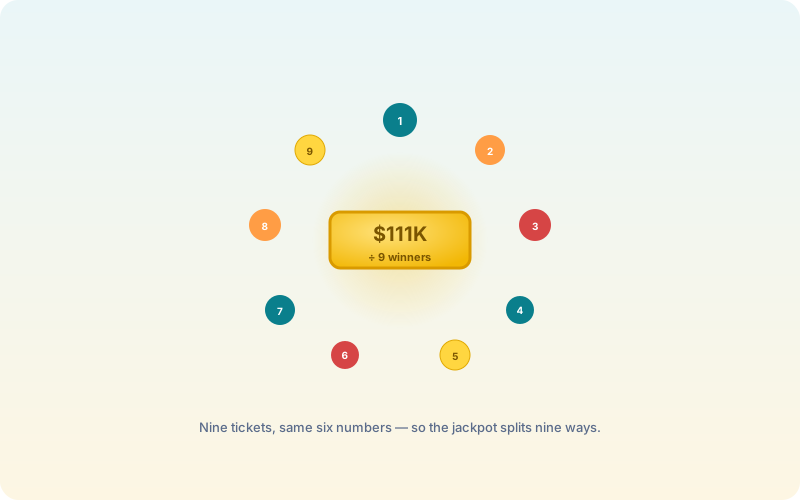
So, in Lotto, the First Division prize isn't a fixed jackpot—it's a pool of money that gets shared among everyone who matches all six numbers. In Draw 2606, that pool was $999,999. Nine winners came forward, so each took home exactly $111,111 (because $999,999 divided by 9 is $111,111—nice and tidy, right?). Compare that to the draw on 1 August 2026, where there was one winner and they scooped the full $1,000,000. Same division, same odds of matching six numbers, but a totally different payout depending on how many people are in the winner's circle.
It's a bit like a pizza—if you're the only one at the party, you get the whole thing. If nine friends show up, you each get a slice. The pizza doesn't change size; it's just how many slices you cut. And in Lotto, that pizza is the prize pool, which is set by ticket sales and rollovers, not by how many winners there are.
Why does this happen?
You might wonder: how do nine people all pick the same six numbers? Well, it's not magic—it's just probability and human nature. Some numbers are more popular than others (birthdays, lucky sevens, that sort of thing), so certain combinations get picked more often. When a less common combination comes up, you might get one or two winners. But when a 'popular' set of numbers hits, suddenly you've got a queue of people holding the same ticket. That's why the prize can swing so wildly from draw to draw.
The important thing to remember—and I say this kindly, because I know we all love a bit of dreaming—is that no strategy, pattern, or system can improve your odds. Each number combination is just as likely as any other. The lottery is pure chance, and that's what makes it exciting. So, if you play, treat it as entertainment, and only spend what you're comfortable with—like you would on a movie night or a fancy coffee.
A silver lining for the winners
Now, I know $111,111 might sound like a letdown compared to a million, but let's put it in perspective. That's still a life-changing amount for most people. It could pay off a mortgage, fund a kid's education, or take a year off work to travel. And hey, those nine winners are probably having a much better week than the rest of us—they've got a tidy little windfall, and they've got a great story to tell at the pub.
What I find fascinating is how the prize pool maths works out so neatly. That $999,999 across nine winners gives that lovely repeating number—111,111. It's almost like the universe wanted to make it easy to remember. But that's just a coincidence, of course. The randomness of the draw is what it is.
The bigger picture
So, next time you see a small First Division prize, don't be disappointed. It's just a sign that more people got lucky that week. And if you ever win, whether it's $111k or $1M, the joy is in the surprise, not the size. For me, watching the numbers is part of the fun—I love seeing how the pools and winners interact. It's a little puzzle every week, and this week's was a doozy.
Anyway, that's my take on the $111,111 draw. It's a good reminder that in Lotto, as in life, sharing can mean you get less—but it also means more people get to smile. And that's not a bad trade-off, is it?

Fancy your own set of numbers?
I'll pick 30 fresh lines for the next draw — hot, balanced and wild card.