
Why 57,000 of Us Played When It Hit $40M

I had to do a double-take when I saw those figures sitting side by side. Fifty-seven thousand versus fifteen thousand—that’s not a gentle uptick, it’s a tidal wave. When the Powerball jackpot hit that whopping $40 million back in July, nearly four times as many of us walked away with a prize compared to the $6 million draw just over a week later in August. It’s fascinating, really. Not necessarily the winning part, but watching how we all collectively sit up straighter and dig into our wallets when those billboard digits climb into “never work again” territory.
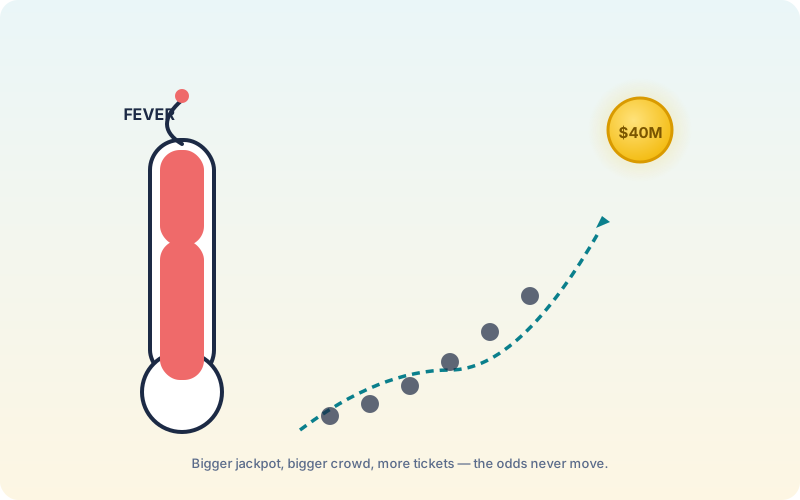
The fever is real
Let’s be honest about what those numbers reveal. When the jackpot swells to $40 million, we’re not just buying a ticket; we’re buying a daydream. The data from late July shows 57,379 Powerball winners, which tells me an enormous number of tickets were sold that week. Compare that to the 15,720 winners on August 5th when the prize was a comparatively modest $6 million, and you can see the psychology plain as day. Six million dollars is life-changing money, sure, but forty million? That’s island-buying, tell-the-boss-where-to-go kind of money. It triggers something primal in us—the collective “what if” that has queues snaking out the dairy door.
The odds haven’t budged an inch
Now, here’s where I put my numbers hat on properly. I need to be crystal clear about this: every single Lotto draw is completely random. The balls don’t know how big the prize is. The machine doesn’t get looser or tighter depending on the jackpot. Your odds of winning Powerball are exactly the same whether you’re playing for $6 million or $40 million. There is no strategy, no pattern, no system that can improve your chances. None. I know that’s not as exciting as a secret formula, but it’s the truth, and I’d rather you heard it from me than spent money you don’t have chasing a myth.
Buying the dream, not the guarantee
So why do we do it? Why does the country go slightly mad when the jackpot bulges? Because for the price of a coffee, you’re purchasing permission to fantasise for forty-eight hours about what you’d do with all that zero-heavy cash. It’s entertainment, pure and simple. As long as you’re playing within your budget and treating it like a movie ticket or a flutter on the races—money spent for the enjoyment, not as an investment—then there’s no harm in the fantasy. That shared excitement, the office syndicates, the “what colour would your Ferrari be” conversations over dinner—that’s the actual prize we’re all winning when the jackpot soars.
I love watching the data roll in after these big draws. There’s something wonderfully human about seeing those participation spikes, watching rational adults calculate how they’d distribute forty million dollars between their cousins and the SPCA. Just remember that the randomness is what makes it fair, and the dream is what makes it fun. The numbers will do what they do, and whichever side of the winner’s ledger you land on, the real joy is in the anticipation—not in any guarantee of riches.
Fancy your own set of numbers?
I'll pick 30 fresh lines for the next draw — hot, balanced and wild card.