
Why NZ Lotto jackpots climb in $2M steps (and where the cash comes from)

The first thing I thought: 'That's a very tidy ladder'
I just read the news about the 2026 jackpot ladder – the one that goes $5M, $6M, $8M, $10M, all the way up to $40M – and honestly, my first reaction was a little sigh of contentment. Numbers have a way of being either chaotic or beautifully structured, and this is the latter. It's not random jumps; it's a deliberate, published path. And the $2M step? That's the bit that gets people asking me, 'But Mia, where does that extra money actually come from?' So let's pull it apart, because it's simpler than you might think – and no, it's not some hidden vault.
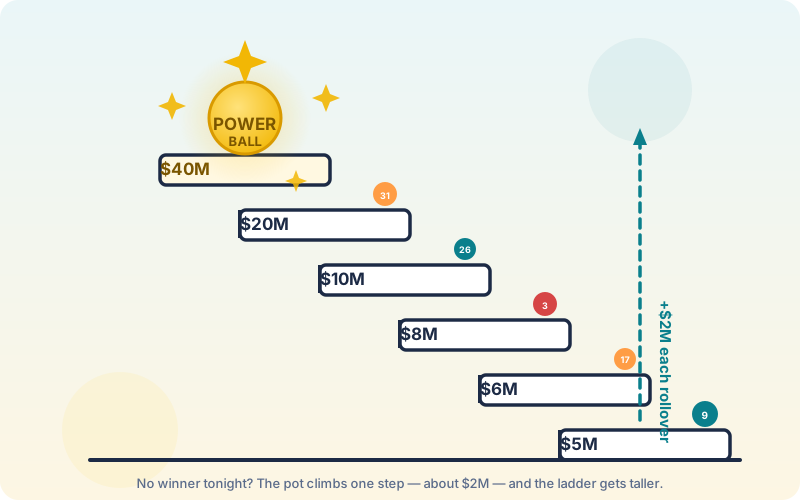
The $2M isn't 'new' money – it's recycled tickets
Here's the thing: every time there's a draw and nobody wins the jackpot, that prize money doesn't just sit there twiddling its thumbs. It rolls over into the next draw. But the $2M step isn't just the previous jackpot sitting still – it's the previous jackpot plus a fresh contribution from that week's ticket sales.
Think of it like a shared pot at a dinner party. Everyone chips in for the meal. If nobody guesses the exact bill amount, the leftover cash goes into next week's pot, and then everyone chips in again. The $2M step is roughly the amount that gets added from the 'new' tickets sold for the next draw – a combination of the standard jackpot contribution (usually around 50-60% of ticket revenue goes to prizes, and a chunk of that goes to the jackpot) plus any interest or extra contributions from the lottery operator. So when you see $8M jump to $10M, that's not the jackpot 'earning' $2M on its own – it's the rolled-over $8M plus about $2M in fresh sales from people buying tickets for that next draw.
Now, a quick reality check, because I always want to be straight with you: the draws are random. No pattern, no system, no 'ladder strategy' can improve your odds. The ladder is just a transparent way of showing how the prize grows – it's not a roadmap to winning. It's entertainment, and it's fun to watch, but it's not a mathematical edge. I just like to say that once, clearly, so we're all on the same page.
The 2026 ladder: a few interesting bumps
Let's look at the actual numbers you've got there: 5M -> 6M -> 8M -> 10M -> 12M -> 14M -> 17M -> 20M -> 23M -> 25.5M -> 28M -> 30M -> 35M -> 40M.
Notice the first step is only $1M (from 5 to 6) – that's because the starting jackpot is usually a 'guaranteed' amount, and the first rollover often just adds the minimum. Then it settles into the $2M groove for a few steps. But then you see 14M -> 17M – that's a $3M jump. Why? Because sometimes there are 'boosted' draws or special promotions that add a bit extra. Similarly, 25.5M is an odd number – that's likely a point where the jackpot had an additional contribution from a specific game or a one-off top-up. And then 30M -> 35M -> 40M – those are bigger $5M jumps, probably because the ticket sales go up dramatically as the jackpot gets huge, so the rollover contribution increases. It's not a fixed law; it's a guideline. The $2M is the 'usual' rate, but the ladder flexes based on how many people are playing.
For context, if you're buying a ticket for a $30M draw versus a $10M draw, you're not just buying a chance at a bigger prize – you're also contributing to the pot that will make the next step even bigger if nobody wins. That's the beautiful, slightly self-perpetuating cycle of it all.
The human side of the ladder
I think the reason the $2M steps feel so satisfying is that they're just enough to feel like a real 'jump' without being scary. A $2M step is – let's see – roughly the cost of a very nice house in Auckland, or a small fleet of electric cars, or about 400,000 Lotto tickets. It's a tangible amount. And when you watch the ladder climb week after week, it creates a narrative – a story of 'will anyone get it this time?' It's not just about the money; it's about the anticipation.
But here's my honest thought as someone who stares at these numbers for a living: the ladder is a marketing tool as much as a mechanical fact. It's designed to keep you engaged, to make you feel like the prize is 'growing' in a way that feels structured and exciting. And that's okay – as long as you remember it's entertainment. I always say, play within your budget – whatever that looks like for you, just make sure it's an amount you're comfortable losing, because that's the reality of a random game. The ladder is fun to watch, but it doesn't change the odds one bit.
So, what's my final take?
I love that they've published the ladder openly. It demystifies the process – you can see exactly how the prize might climb if nobody wins, and that transparency is good. The $2M steps are just the natural result of ticket sales feeding the pot, with a few bumps and boosts along the way. It's not magic, it's not a system, it's just arithmetic and a bit of human enthusiasm. Next time you see that $2M jump, you'll know – it's not the jackpot 'growing' on its own. It's you, me, and everyone else buying tickets, all quietly adding a little bit to the next dream. And that, I think, is rather lovely.

Fancy your own set of numbers?
I'll pick 30 fresh lines for the next draw — hot, balanced and wild card.