
Who Actually Buys Lotto in NZ? What It Means for Ordinary Kiwis vs the Wealthy

With Powerball riding a record rollover streak, it's worth asking a question nobody usually checks the data for: who is actually buying these tickets — and does the lottery mean something different for someone earning $40,000 versus $400,000?
The short answer: yes, and the numbers are surprisingly even in New Zealand.
Who buys Lotto in New Zealand — the official picture
Lotto NZ publishes its player data through national health surveys and annual reports. The picture:
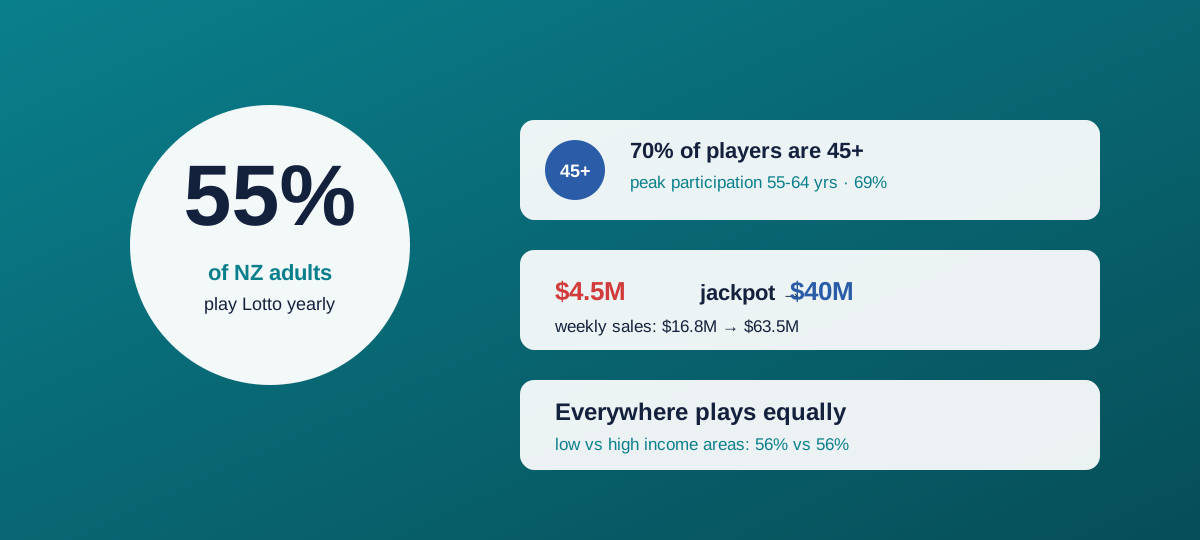
- About 55% of New Zealand adults buy a Lotto product at least once a year (the official HealthNZ range is 51-57%, roughly 2.4 million adults).
- Only 11-13% of adults are core players who play every single draw.
- Players skew middle-aged and older — around 70% of players are 45+, with participation peaking at 55-64 years old (about 69% of that age group plays).
- Participation is remarkably even across the country, including across richer and poorer neighbourhoods: roughly 56% of adults in high-deprivation areas play, versus 56% in low-deprivation areas.
That last point matters. In the United States, the lottery is famously regressive — low-income households spend a much larger share of their income on tickets. In New Zealand, Lotto looks much closer to a genuine national pastime than a tax on the poor, at least at the participation level.
What a bigger jackpot does to who plays
Lotto NZ's own sales table shows exactly how jackpot size pulls people in (Saturday Powerball, weekly ticket sales):
| Jackpot | Weekly sales |
|---|---|
| $4.5M | $16.8M |
| $10M | $18.6M |
| $15M | $20.4M |
| $22M | $25.4M |
| $30M | $36.3M |
| $40M | $63.5M |
A $40 million jackpot multiplies weekly sales almost four-fold over a small one. Research on the American Powerball explains why: at moderate jackpots the players skew lower-income, but as the prize climbs toward the tens of millions, participation widens — the "convenience store worker, the teacher, the doctor, the lawyer" all buy in. Economists call it the jackpot's fun value crossing the threshold where the ticket feels like entertainment rather than an expense.
What Lotto means for an ordinary player
For most Kiwis, a Lotto ticket is a small, priced piece of hope — a few dollars for a few days of "what if". At roughly $1.60-$6.80 per ticket (depending on lines and Powerball), played in moderation it's comparable to a coffee or a movie snack.
The research is blunt about the risk, though. A Carnegie Mellon experiment found people made to feel poorer bought nearly twice as many lottery tickets as a more affluent-feeling group — the same people for whom every dollar matters most. The danger isn't the occasional ticket; it's when the ticket becomes a substitute for financial planning.
Two official safeguards exist in NZ: MyLotto enforces a $150/week (or $500/month) spending cap, and every dollar you play partly funds your own community — about 25 cents of every $1 goes to the Lottery Grants Board, which distributed roughly $370-395 million a year to sports, arts and rescue groups. When you play Lotto NZ, you're also funding Kiwi communities.
What Lotto means for a wealthy player
For someone with substantial wealth, a lottery ticket is closer to pure entertainment — a $10 ticket is a rounding error, the odds are understood as astronomically low, and the "dream" is a fun dinner-table conversation rather than a life raft. Higher-income players are more likely to buy into big jackpots (where the entertainment value feels worth it) and less likely to play small instant games regularly.
In other words: the same ticket can be a harmless thrill for one person and a meaningful drain for another — not because the odds differ, but because the ticket means something different in each budget.
The honest bottom line
- For everyone, the odds are the same: roughly 1 in 38 million for Powerball Division 1.
- Lotto is entertainment with a community dividend, not an investment and not a financial plan.
- If you play, set a budget you'll never miss, treat any win as a bonus, and never chase losses with money you can't afford.
The data says Kiwis of every income play — and that's fine, as long as the ticket stays what it's meant to be: a small price for a little hope, not a plan for a better life.

Fancy your own set of numbers?
I'll pick 30 fresh lines for the next draw — hot, balanced and wild card.