
Does a Syndicate Improve Your Odds in Lotto?

The two questions people merge into one
When people ask "does a syndicate improve your odds?" there are really two separate questions hidden inside. The first is: does buying more lines as a group change the chance that someone in the syndicate will win? The chance that the group wins something at all does increase with more lines, but this does not mean your personal chance of winning increases. The second question is: does being in a syndicate change what each player individually can expect to get back? The answer to this is no.
It’s important to keep these questions separate because mixing them up is very common, but it leads to confusion. A syndicate changes the chance the group gets a prize, but since any winnings are shared, your personal expected return stays the same. Let’s see what the numbers say.
What a group of lines does to the chance of any win
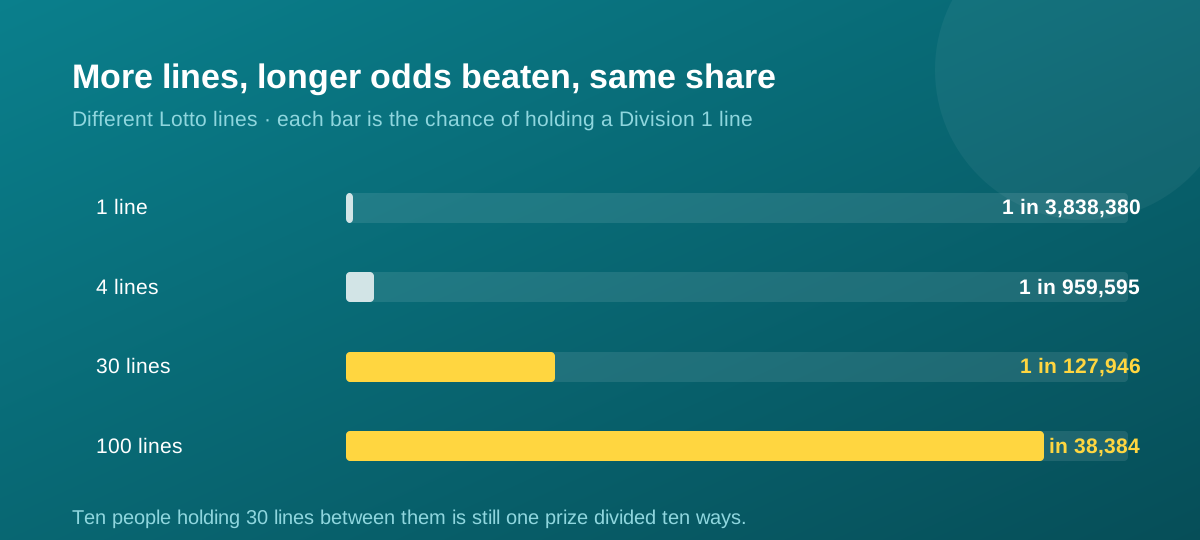
Lotto Division 1 odds for a single line are famously long: 1 in 3,838,380. That makes winning on just one line very unlikely — but when a syndicate buys multiple lines, these long odds improve for the group.
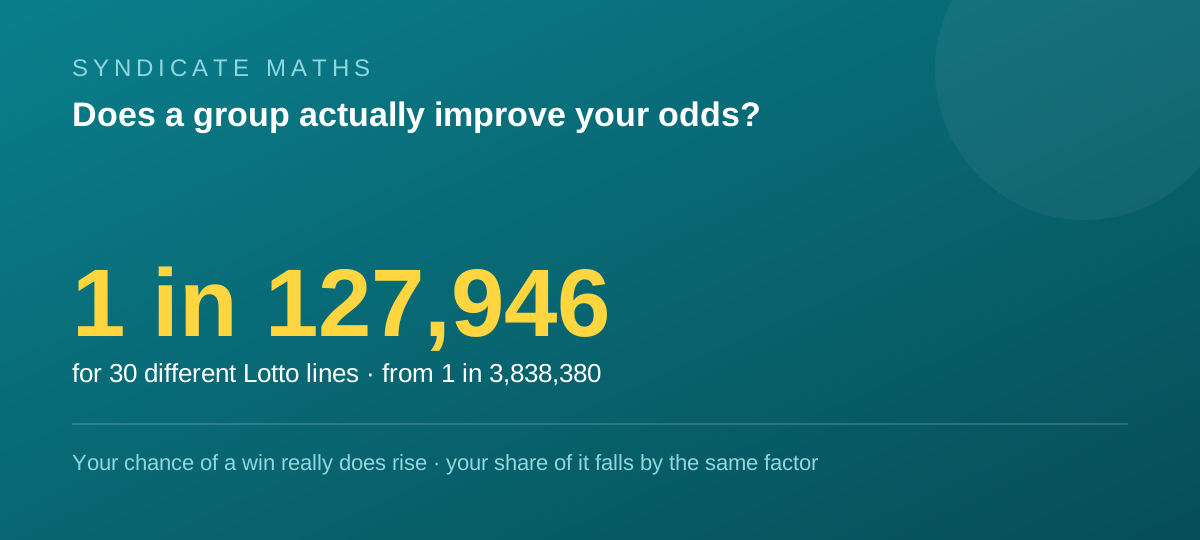
For example, if you pool 30 different Lotto lines, the odds that at least one of those lines will win Division 1 rises to about 1 in 127,946. That means the group’s chance of winning is higher compared with one line, but this is a group chance, not an individual one. Similarly, 100 different Lotto lines improve the group's odds to about 1 in 38,384.
For Powerball, the odds per line are even steeper at 1 in 53,737,320, but buying 30 lines as a group improves the chance to about 1 in 1,791,244.
The logic is straightforward: more different lines means more chances for the group. Each line is an independent shot at the jackpot, so buying more lines increases the probability that someone in the group gets a win.
What it does to your share
While a syndicate’s chance of winning goes up by pooling lines, the prize is shared among all members. If your syndicate has 30 players and wins, the prize is divided into 30 parts, so each person’s payout is about one thirtieth of the total.
This means the upside changes in proportion to the size of the group. If the syndicate wins $30 million, with 30 players you get $1 million each before tax. The more people sharing, the smaller your prize share.
This sharing rule is the same regardless of whether the jackpot is shared with other winners outside your syndicate. For example, one of the largest Division 1 shared wins in our archive happened on 19 September 2018 when 40 winners each received $25,000. That was a Division 1 prize shared among many winners, reducing individual shares.
Why the expected return is unchanged
A common misconception is that a syndicate improves your personal chance of winning. Actually, your expected returns remain about the same.
Expected return can be thought of as the average amount you would win per dollar spent, accounting for both chance and prize size. When you play alone with one line, your chance of winning is low, but you keep the full prize if you win. When you play in a syndicate, your chance of winning any prize on your line is the same as if you bought it alone, but your share of any prize is only a fraction of the total because of sharing.
The increase in the group's overall chance of winning does not translate into an increase in your own expected return because your prize share decreases proportionally with the number of people sharing.
Real examples of shared jackpots
Sharing lotto winnings in NZ is quite common. In our records, there have been 754 Division 1 prizes shared among multiple winners. The largest number of winners on one Lotto Division 1 prize was 40 on 19 September 2018, each receiving about $25,000.
Powerball jackpots tend to have fewer winners sharing; the most on record was three winners on 15 November 2025, sharing $18,388,889 each. Recently, on 25 July 2026, a $40 million jackpot was split between two tickets, resulting in two shares of about $20,111,111 each.
Sometimes, jackpots are capped (Powerball cap is $60 million), which can influence prize sizes but not the fundamental maths of sharing.
Where a syndicate genuinely helps, and where it does not
A syndicate genuinely helps when your goal is to increase the group's chance of having some winner among you — that is, the group as a whole has better odds than any one individual line.
However, it does not help if your goal is to get a better average return per dollar you spend or to improve your personal chance of winning a prize on your own lines. The expected payout per dollar spent remains constant whether you play alone or in a group, assuming shared winnings are split fairly.
If you want to learn more about running a syndicate well, how sharing works when two tickets win the same numbers, or how lotto odds compare across games, check out these resources:
The main takeaway is that playing in a syndicate means more lines and a better chance the group wins something, but your personal expected return and chance per line do not improve because the prize is shared. This is just how independent random draws work.
If gambling stops being fun, free support is available from the Gambling Helpline on 0800 654 655.
Quick answers
Does joining a Lotto syndicate increase my personal chance of winning?
Joining a Lotto syndicate increases the chance the group wins something, but your personal chance of winning on any specific line remains unchanged. Each ticket retains the same odds whether played alone or in a group.
How does sharing lotto winnings in NZ work in a syndicate?
When a syndicate wins, the prize is divided among all members according to their share in the group. For example, if 30 people share a jackpot, the prize is split into 30 parts, reducing each member's individual payout.
What are the odds of winning Lotto Division 1 with multiple lines?
Single Lotto Division 1 odds are 1 in 3,838,380. With 30 different lines, the group's odds improve to about 1 in 127,946. With 100 lines, odds improve to about 1 in 38,384, but this is a group chance, not an individual one.
Are syndicates a good way to improve my expected return on Lotto?
No. While syndicates increase the group's chance of winning, your expected return per dollar spent remains the same because any winnings will be shared among the group members.

Fancy your own set of numbers?
I'll pick 30 fresh lines for the next draw — hot, balanced and wild card.