
What Happens If Two People Pick the Same Lotto Numbers?

Kia ora! Here is a question I get in two flavours. From the anxious: "What if someone else has my numbers?" And from the hopeful: "If two of us win, do we each get the full amount?"
The answers are different, and both come down to one distinction the game does not explain very well: which prizes are pools and which are fixed amounts.
Identical numbers are separate entries
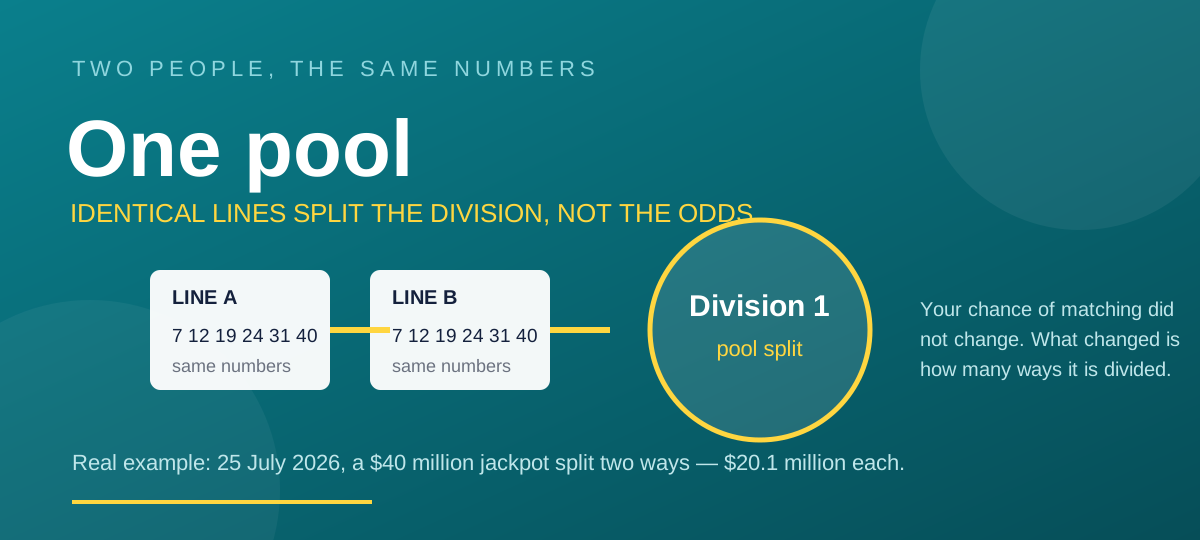
First, the bit that reassures people: two players choosing the same six numbers do not interact in any way. Each line is its own entry against the same draw. Your chance of matching those numbers is exactly the same whether one other person in the country picked them or a million did.
What changes is what happens after the numbers land.
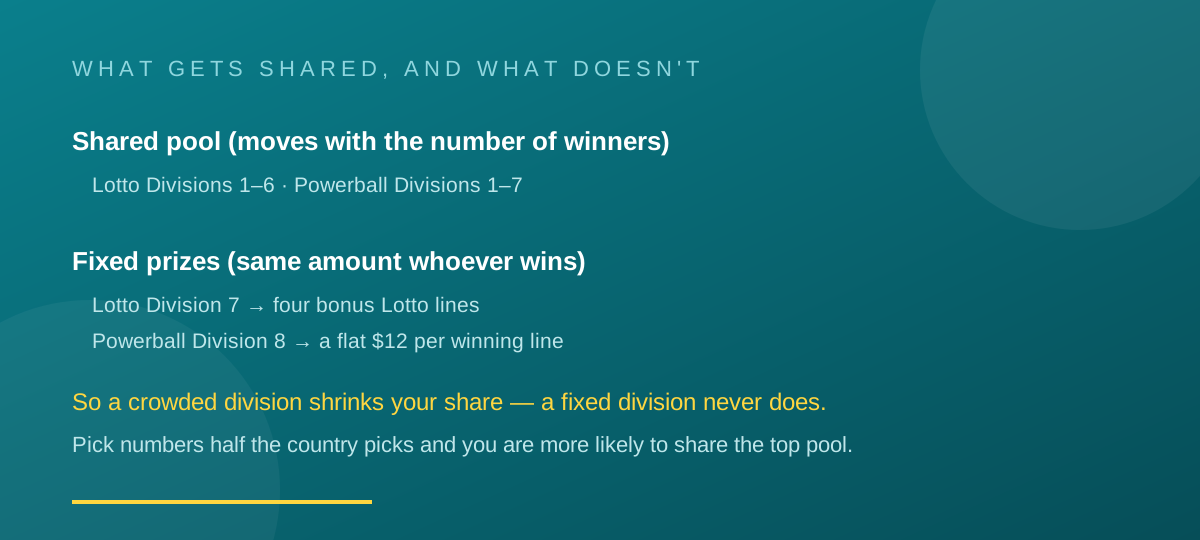
This is the heart of it. In Lotto, Divisions 1 to 6 are pool-based — there is a pot of money for that division, and it is divided equally between all the winning lines. Powerball works the same way in Divisions 1 to 7. So if your numbers come up and 19 other people wrote them down too, there are 20 of you looking at the same pot.
Two divisions behave differently: Lotto Division 7 pays four bonus Lotto lines rather than cash, and Powerball Division 8 — the new bottom rung added with the 14-ball format in September 2026 — pays a flat $12 per winning line. Here is the full division ladder if you want to see which is which at a glance.
What a split looks like in real money
New Zealand has plenty of fresh examples, because we have just had a run of very shared jackpots.
- 25 July 2026, draw 2606: a $40 million Powerball jackpot was won by two tickets, paying just over $20.1 million each. One of those two tickets then sat unclaimed for nearly two months — found eventually inside a book, where it had been working as a bookmark.
- A $10 million Must Be Won night shared two ways, so $5 million each.
- A Lotto First Division pool divided so widely that each winning line took home $111,111. I dug into that particular draw in why First Division paid just $111,111 because it is the clearest illustration of how a pool thins out.
Notice the direction of travel: the headline number stays the same, the cheque does not. A $40 million jackpot is not a $40 million cheque in your hand unless you are the only winner — and one line only, at that.
Why some numbers get shared more often
Here is where the psychology matters more than the maths. Your odds of matching do not change based on which numbers you choose. But the number of other people likely to be holding your numbers does.
Anything that feels personal is popular: birthdays (so 1–31, heavily weighted to the low teens and single digits), the numbers 7 and 11, patterns on the ticket grid, and any line that reads nicely in a row. Those pick the same combination as thousands of other people, which means a pool-based division gets sliced into much smaller pieces when they win.
The flip side of that — deliberately choosing numbers nobody else likes — does not improve your chance of winning by even a fraction. It only means that if the improbable happens, you are less likely to be standing in a queue of winners. I went through the pattern question properly in whether to pick consecutive numbers or spread them out, and the honest conclusion is that it is a question about sharing, not about luck.
The three things worth remembering
- Someone else having your numbers cannot cost you a win. It can only change what a shared division pays.
- Pool divisions = equal shares. Everyone in the division gets the same amount, on the same night.
- Fixed divisions ignore the crowd. Division 7's bonus lines and Powerball's $12 Division 8 are the same for one winner or ten thousand.
And the honest footnote
Sharing is not a flaw in the game, it is the arithmetic of pools — and it cuts both ways. On the night in July 2026 when two tickets split $40 million, both winners still took home more money than most people see in a lifetime. On a night when 30 lines share a division, everyone gets a story and a far smaller cheque.
Which is the whole point of my job here: knowing which is which before you buy, not after. Our Powerball frequency breakdown and the number explorer will tell you what has been drawn, and neither of them will tell you what to pick. That is still yours.
If gambling has stopped being entertainment for you or someone close to you, Gambling Helpline NZ is free, confidential, and available 24/7 on 0800 654 655.
Quick answers
If two people pick the same numbers and both win, do they split the prize?
In Lotto Divisions 1 to 6 and Powerball Divisions 1 to 7, yes — those are pool-based divisions, and everyone who matches shares that night's pool. In Division 7 (four bonus lines) and the new Powerball Division 8 ($12), the prize is fixed, so sharing is not an issue.
Does someone else having my numbers reduce my chance of winning?
No. Your chance of matching the numbers is unchanged. What changes is how many ways the pool is divided if you do win — which is why crowd-favourite numbers are more expensive to win with.
How much can a shared First Division actually pay?
It varies wildly. In July 2026 a $40 million Powerball jackpot was split two ways, paying just over $20.1 million each. In another draw the Lotto First Division pool was shared so widely that each winner received $111,111.
Should I avoid popular numbers like birthdays?
Only for one reason: if you win a pool-based division, popular combinations are more likely to be shared. It does not change your odds of matching at all, so it is a question about how much you would keep, not how likely you are to win.
Can two winners in the same division get different amounts?
No. Within a pool-based division the pool is divided equally between the winning lines, so each line receives the same amount. Fixed divisions pay the same amount to every winner by design.
What about Powerball Division 8 - is that shared?
No. Division 8, introduced with the 14-ball Powerball in September 2026, pays a flat $12 per winning line. It is a fixed prize, so more winners does not shrink it — unlike Division 1, which is a shared pool.
Fancy your own set of numbers?
I'll pick 30 fresh lines for the next draw — hot, balanced and wild card.